
Validity of GNSS-RO as a model input
Global Navigation Satellite System Radio Occultation (GNSS-RO) is a well-established, space-based observing technique that measures the bending of GNSS signals as they pass through Earth’s atmosphere. These measurements provide highly accurate, vertically resolved profiles of temperature, pressure, and humidity, unaffected by clouds or precipitation. RO has the unique feature of not needing calibration and the data is able to be assimilated without bias corrections and therefore act as anchors to reduce model biases as well as biases in other observations (Bauer et al., 2014). Because of their precision, global coverage, and long-term stability, GNSS-RO observations are widely recognized as a reliable and unbiased input to numerical weather prediction (NWP) models. They have the greatest impact in the upper troposphere-lower stratosphere.
Radiosondes have long been a standard tool in weather forecasting, but they face limitations in sparsely populated regions such as the poles and open oceans. GNSS-RO profiles help fill these gaps in NWP models, providing radiosonde-like vertical resolution with truly global coverage and much higher sampling density. In a study by Shao et al. (2021), RO data from the COSMIC-2 mission were compared with co-located radiosonde measurements of temperature and humidity. For temperature, the RO and radiosonde observations matched closely between 12.5 and 16.5 km altitude (Figure 1). A small warm bias appeared above 17.8 km during daytime conditions. The largest temperature differences occurred between 8 and 11 km, approaching 0.5°C.
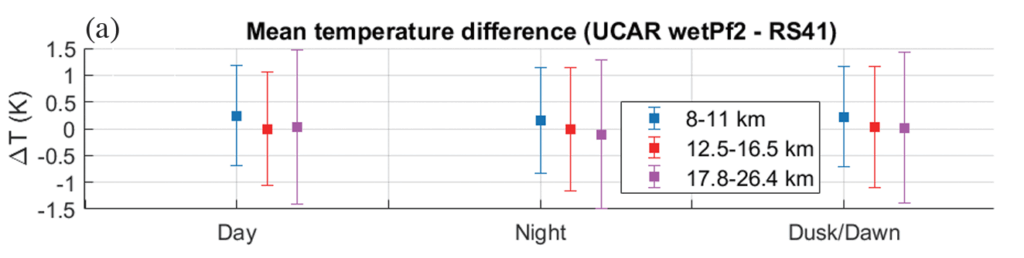
Figure 1: Mean temperature differences between co-located COSMIC profiles (retrieved by UCAR) and Vaisala RS41 radiosonde profiles during daytime, nighttime, and dusk/dawn (Shao et al., 2021).
When performing a similar comparison for humidity, the GNSS-RO and radiosonde retrievals were generally consistent throughout the troposphere, particularly above 4.8 km (Figure 2). Below 4.2 km, the RO data showed a wet bias relative to the radiosondes, due in part to slight dry biases in the daytime sonde measurements. Overall, the GNSS-RO temperature and humidity profiles aligned closely with radiosonde observations. With their superior availability and global coverage, GNSS-RO profiles can be used interchangeably with sondes in NWP and AI-based weather models.
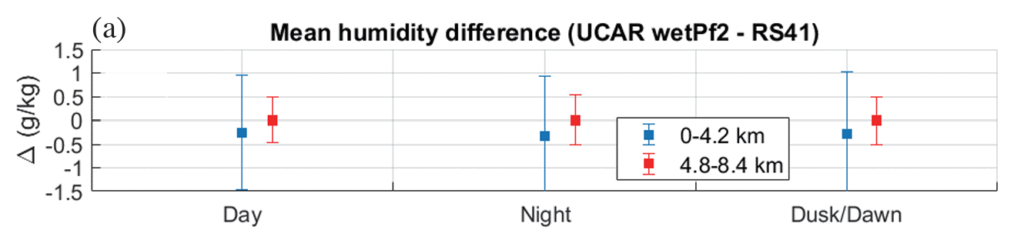
Figure 2: Mean humidity differences between co-located COSMIC profiles (retrieved by UCAR) and Vaisala RS41 radiosonde profiles during daytime, nighttime, and dusk/dawn (Shao et al., 2021).
Importance of the GNSS-RO contribution in NWP
GNSS Radio Occultation (GNSS-RO) has been a critical data source for numerical weather prediction (NWP) models for many years. Numerous studies have investigated both the impact of RO observations on forecast quality and the optimal number of profiles to assimilate. To explore these effects in greater depth, the Radio Occultation Modelling Experiment (ROMEX) was proposed and conducted in 2024. In ROMEX, several leading NWP centers assimilated approximately 35,000 RO profiles per day into their NWP models for a defined study period, using data from both government and commercial satellite providers, including PlanetiQ.
Key results from ROMEX were presented by the International Radio Occultation Working Group (IROWG) and summarized in Shao et al. (2025). The findings reaffirmed earlier evidence that increasing the number of assimilated RO profiles consistently improves global forecasts of temperature, humidity, and wind, particularly in the mid- to upper-atmosphere, across major NWP centers including ECMWF, DWD, UKMO, and KMA. Additionally, NOAA/NESDIS and the University of Maryland reported that greater RO data volume led to a significant reduction in short-range tropical cyclone intensity forecast errors.
At ECMWF, Lonitz (2024) presented that the Forecast Sensitivity to Observation Impact (FSOI) for GNSS-RO data was higher than for any other meteorological input, including radiosondes and microwave soundings (see Figure 3, and note that GNSS-RO is referred to as GPSRO). Similarly, the UK Met Office (Joo et al., 2012) reported that, on a per-observation (i.e. per profile) basis, GNSS-RO provided the largest mean observation impact among all satellite techniques, identifying it as one of the most promising tools for improving short-range forecasts (see Figure 4).
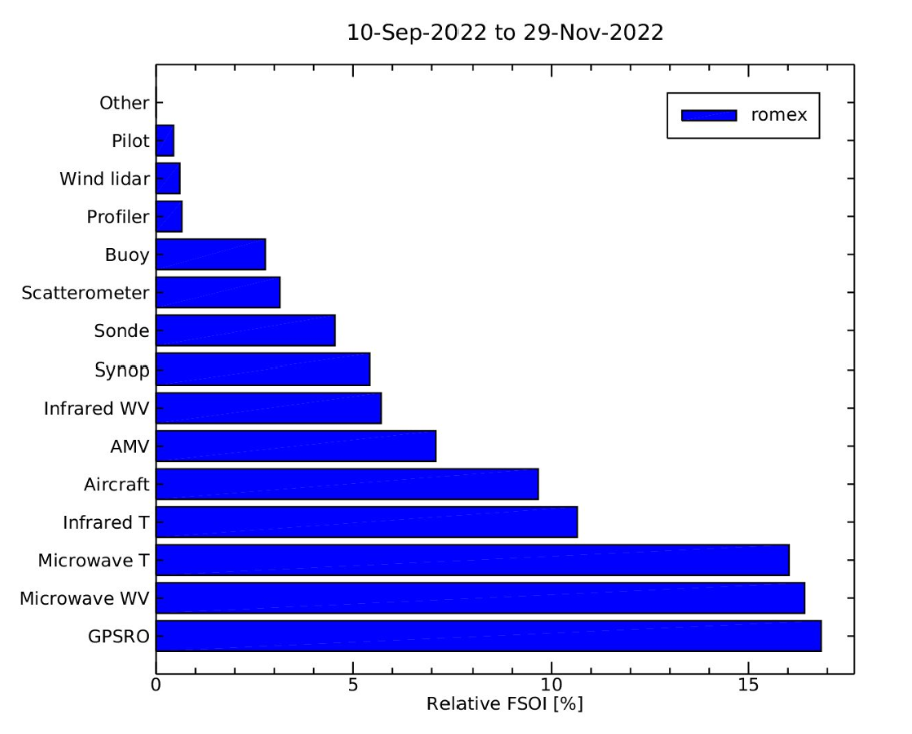
Figure 3: Relative FSOI per technique (Lonitz, 2024). GNSS-RO is referred to as GPSRO by the study authors.
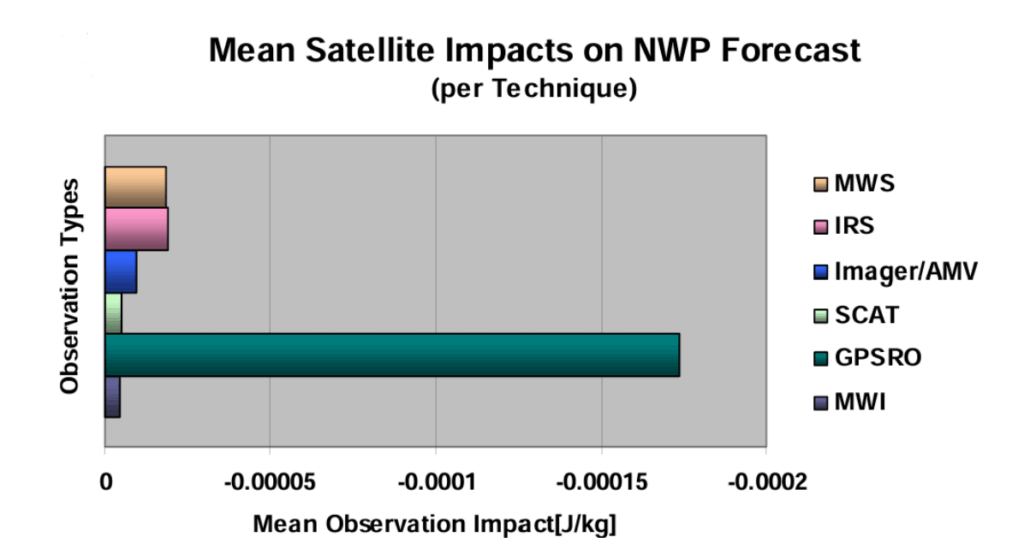
Figure 4: Mean observation impact on NWP forecast per technique (Joo et al., 2012)
The Meteo-France team found during ROMEX that their 2022 results showed a substantial increase in the Degree of Freedom for Signal (DFS) when GNSS-RO was integrated into the model (Raspaud, 2025). Although GNSS-RO accounted for only 19.79% of the assimilated data, it contributed 41.83% of the total DFS increase (see Figure 5).
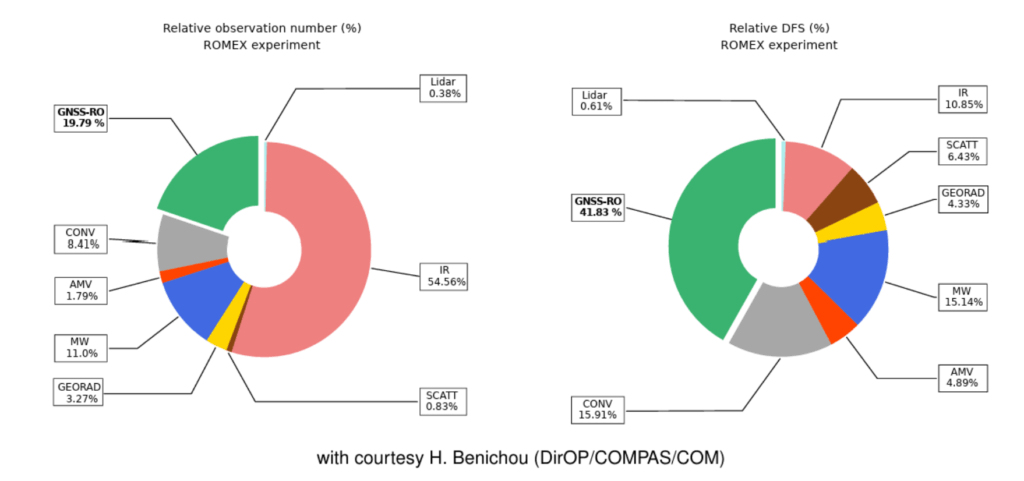
Figure 5: GNSS-RO and other input as a percentage of observations assimilated into the model (left) and as the percentage of DFS (right). From Raspaud, 2025.
Finally, the statistical study done by Prive et al., 2022 found that assimilating 50,000 or more RO profiles daily makes GNSS-RO the dominant satellite data source for reducing forecast errors, especially in the Tropics. This study also indicates that forecast improvements continue even beyond 100,000 profiles per day with no saturation, with the limiting factor becoming a cost-benefit consideration rather than diminishing scientific return.
Implementation of RO in models and future recommendations
GNSS-RO is currently being incorporated into top operational NWP models worldwide, including those at NOAA, ECMWF, and other leading weather centers. It has also begun to play a role in machine learning (ML) and artificial intelligence (AI)–based global weather prediction systems. One such model, FuXi (Sun et al., 2024), employs advanced techniques to transform GNSS-RO data into a gridded format that facilitates integration into AI models using the PointPillars approach. This process discretizes and aligns the data with the model grid, converting it into a set of “pillars” before transforming it into a gridded structure. After training the model with one year of data, the researchers conducted a data denial experiment and found significant degradation in geopotential fields—affecting temperature, humidity, and wind—when GNSS-RO data were excluded.
The future of GNSS-RO as a critical input to both NWP and AI-based models is assured, and its utilization and impact continues to expand. As reported in Shao et al. (2025), current NWP systems still underutilize RO data in the lower troposphere, often discarding valuable information at the top of and within the planetary boundary layer (PBL). Recommendations from ROMEX include enhancing PBL profiling through technological and retrieval improvements, better assimilation of lower-troposphere data, and expanded use of RO-derived water vapor information.
In 2025, NOAA procured 500 enhanced high-signal-to-noise ratio (SNR) profiles from PlanetiQ (in addition to 6500 standard SNR profiles) to evaluate high SNR impact on model performance. PlanetiQ is currently the only commercial provider of this high-SNR data and, notably, supplied more total RO profiles to NOAA than any other vendor over the 2024-2025 and 2025-2026 contract years. As international NWP centers continue to expand and extend their data assimilation capabilities and performance and new AI forecasting systems emerge, the demand for high-quality GNSS-RO observations will continue to accelerate.







Comments are closed.