
by Karen Dubey
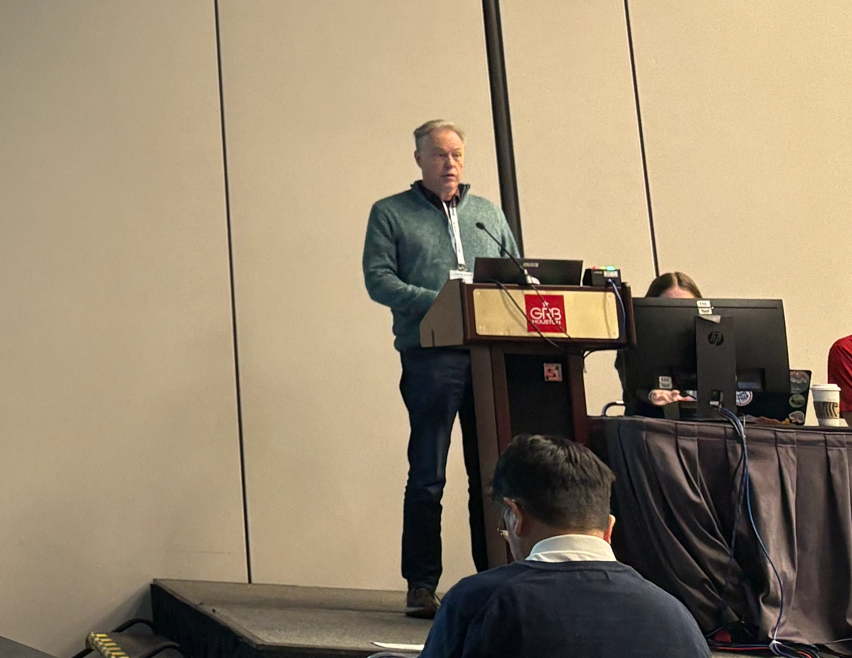
PlanetiQ, a leading provider of commercial GNSS-RO and GPS-RO data, presented three scientific studies at the 105th American Meteorological Society Annual Meeting in New Orleans, Louisiana. The conference is one of the premier meteorology and atmospheric science events in the United States, bringing together researchers, operational weather agencies, and industry leaders.
The presentations featured work from PlanetiQ scientists and researchers including Rob Kursinski, Jonathan Brandmeyer, Brian Giesinger, and Xuelei Feng.
All three studies used data collected from PlanetiQ’s constellation of GNSS Radio Occultation (GNSS-RO) satellites. PlanetiQ delivers commercial GNSS-RO data products to government agencies, weather forecasting centers, research institutions, and commercial organizations supporting applications such as:
- Numerical weather prediction (NWP)
- Space weather monitoring
- Ionospheric modeling
- Climate science
- Atmospheric profiling
Advancing Precipitation Detection with GNSS-RO
The first presentation, “PlanetiQ Initial Precipitation Observations via Dual Linear Polarization Radio Occultation Measurements,” focused on precipitation sensing using GNSS-RO observations from the PAZ mission.
The study highlighted PlanetiQ’s proprietary calibration and retrieval techniques designed to isolate precipitation-related signal signatures from radio occultation measurements. Researchers evaluated:
- Differential phase observations
- Noise floor characterization in non-precipitating environments
- Correlation with ERA5 snowfall analyses
- Comparisons against collocated precipitation datasets
Results showed strong agreement with PAZ observations while also demonstrating how the measurements behave differently over land and ocean environments. The work additionally showed reduced sensitivity to changes in surface emissivity and surface conditions.
Improving Lower Troposphere and Boundary Layer Observations
The second presentation, “PlanetiQ GNSS RO Capabilities with a Focus on the Lower Troposphere and Boundary Layer,” examined the importance of high signal-to-noise ratio (SNR) GNSS-RO data for improving atmospheric profiling in the lower troposphere and boundary layer.
The presentation emphasized how high-SNR radio occultation measurements can reduce or eliminate biases in lower atmospheric profiles, particularly in environments affected by atmospheric ducting conditions. Ducting frequently occurs over ocean regions and can introduce significant retrieval challenges if not properly identified and processed.
The study demonstrated the importance of:
- Detecting ducting conditions in GNSS-RO profiles
- Applying specialized retrieval processing
- Improving lower troposphere and marine boundary layer accuracy
These capabilities are increasingly important for operational weather forecasting and next-generation atmospheric models.
Monitoring the Ionosphere and Space Weather
The third presentation, “PlanetiQ Observations of Total Electron Content and Ionospheric Scintillations,” focused on ionospheric monitoring and space weather applications using PlanetiQ GNSS-RO data.
The research described PlanetiQ’s proprietary calibration methods for removing:
- Local multipath effects
- Differential code biases (DCB)
- Transmitter and receiver TEC calibration errors
The study also emphasized the importance of low-latency GNSS-RO data for monitoring rapidly evolving ionospheric conditions. PlanetiQ currently delivers data with an average latency of approximately 35 minutes and is targeting future latency reductions to roughly 10 minutes through next-generation satellite systems.
The presentation concluded with observations and analysis from the May 2024 Gannon geomagnetic storm event.
PlanetiQ’s Continued Presence in Atmospheric Science
PlanetiQ continues to maintain an active presence within the atmospheric science and GNSS-RO research communities. The company plans to return to AMS 2026 with additional technical presentations and an exhibit booth showcasing its commercial GNSS-RO data capabilities for weather forecasting, climate monitoring, and space weather applications.






Comments are closed.